
How much water should you drink at work?
The eight glasses rule, what health bodies actually advise, why your needs change with heat, exercise and size, and a simple plan for the workday.
For most healthy adults there is no single magic number. The US National Academies suggest about 2.7 liters of water a day for women and about 3.7 liters for men, but that counts water from everything you take in, food as well as drinks. The drinks part comes to roughly 9 cups a day for women and 13 for men, and water, tea, coffee and milk all count. European advice is a little lower. At a desk in a comfortable room, the working-hours share usually comes to a glass when you start and one every couple of hours after that, with meals and evenings covering the rest, and more on hot days or after exercise.
The more useful answer is that your body already has two good gauges: thirst, and the color of your urine. This post covers where the famous eight glasses came from, what the official numbers actually mean, why your needs differ from the person at the next desk, and an easy way to spread water across a working day without counting every sip.
Where the eight glasses idea came from
Eight glasses of eight ounces each, about two liters, is the number most people know. Nobody is quite sure where it started. It is often traced to a 1945 recommendation from the US Food and Nutrition Board, which suggested about 2.5 liters of water a day for most adults and then added that most of it is already contained in prepared food. The first half stuck. The second half got lost.
When the kidney physiologist Heinz Valtin went looking for the evidence behind "eight by eight" in a widely cited 2002 review, he found no studies supporting it for healthy adults in a temperate climate. That does not make two liters a bad amount. For plenty of people it is in the right area. It just isn't a rule, and you have not failed the day if you drank six glasses and ate a big bowl of soup.
What health bodies actually say
The official figures are worth knowing, mostly because they are more generous about what counts.
| Source | Women | Men |
|---|---|---|
| US National Academies, total water from food and drink | about 2.7 liters a day | about 3.7 liters a day |
| US National Academies, the part from drinks | about 2.2 liters (9 cups) | about 3.0 liters (13 cups) |
| European Food Safety Authority, total water | about 2.0 liters a day | about 2.5 liters a day |
| NHS in the UK, fluids | 6 to 8 cups or glasses | 6 to 8 cups or glasses |
A few things stand out.
- The American and European figures are "adequate intakes", not minimums. They describe roughly what healthy, well hydrated people take in. They are not a line you fall off.
- Food counts. Fruit, vegetables, soup, yogurt, and rice or pasta cooked in water all add to the total. On a typical diet food supplies a fair share of the day's water, which is why the drinks figure is lower than the total.
- Most drinks count. The NHS says plainly that water, lower fat milk and sugar-free drinks, tea and coffee included, all count toward your fluids. Coffee gets a post of its own: does coffee count as water.
- The figures disagree. The European numbers are lower than the American ones, and the UK advice is lower again. Experts looking at much the same evidence land in somewhat different places, which tells you that precision is not the point.
Thirst and urine color: the gauges you already have
The National Academies' report made a point that gets less attention than its numbers: most healthy people meet their daily needs by letting thirst guide them, along with what they drink at meals. Despite what you sometimes hear, feeling thirsty doesn't mean you are already in trouble. It is your body's normal request for more.
The second gauge is the color of your urine. The NHS and others suggest aiming for pale yellow, roughly the color of straw.
- Pale straw for most of the day: you are probably drinking enough.
- Dark yellow or strong smelling: have some more.
- Completely clear all day, with constant trips to the bathroom: you may be drinking more than you need. Usually harmless, but not necessary.
Some things throw the reading off. B vitamins, common in multivitamins, can turn urine bright yellow. Beets and some medicines change its color too, and the first visit of the morning is often darker anyway.
Both gauges have a weak spot at a desk. When you are deep in work, thirst is easy to tune out, and thirst also tends to get less reliable with age, which is why older adults are often advised to drink at regular times rather than wait to feel thirsty. If you notice you go whole mornings without a sip, why you forget to drink water at your desk covers what is going on and how to fix it.
Why your number differs from your colleague's
The official figures are averages for healthy adults in mild conditions. Several things move your own needs up or down.
- Heat and humidity. A warm office, a stuffy meeting room or a summer commute all mean more sweat to replace.
- Exercise. A lunchtime run, a bike ride to work or a gym session before the office adds a lot. Drink around the exercise, not only at your desk afterward.
- Body size. Larger people generally need more water than smaller people.
- What you eat. Salty food makes you thirstier. A diet heavy in fruit, vegetables and soup supplies more water on its own.
- Pregnancy and breastfeeding. Both raise needs, and the official figures are higher for them.
- Being unwell. Fever, vomiting and diarrhea all lose water quickly.
- Health conditions and medicines. Some heart and kidney conditions call for drinking less, not more, and some medicines change how the body handles water. If a doctor has given you a fluid limit, follow it rather than any general advice, this post included.
More is not always better, either. Drinking very large amounts in a short time can dilute the salt in your blood, which is dangerous. It is rare and mostly seen in endurance events, but it is a good reason not to force down water you don't want.
A simple way to spread water across a workday
You don't need to hit the whole day's total at work. Meals and evenings do some of the lifting. What helps at the desk is a rhythm, so you are not trying to catch up with a liter at 5 PM.
For many people in a temperate office, something like this works:
- A glass when you sit down. Before the first coffee, if you can manage it. You have gone all night without a drink, and the start of the day is the easiest moment to anchor a habit.
- A refill mid-morning. Somewhere between your second meeting and your first proper break.
- A glass with lunch. Meals are a natural cue, and drinking with food is a large part of how most people stay hydrated.
- One in the middle of the afternoon. The 2 to 4 PM stretch is when a lot of people go quiet on water and reach for another coffee instead.
- One before you finish. A last glass as you wrap up, and refill the bottle for tomorrow while you are at it.
That is about five glasses across the working day, before you count meals, tea and whatever you drink in the evening. Add more on hot days or days you exercise, and let thirst and the color check tell you if you are off.
Letting your Mac keep the rhythm
The plan above is easy to agree with and easy to forget by Tuesday. Notchpals has two Water characters, Melo, a watermelon who takes hydration personally, and Puddle, a fluffy seal pup. A crew has room for one of them, and that one keeps the rhythm for you.
Its visits line up with the five glasses fairly closely. The glass when you sit down is its own moment: the first glass of water, once a day between 8 and 11 AM, 15 minutes into your morning at the Mac. The refills in between are the repeating water reminder, which runs from 9 AM to 8 PM. And the mid-afternoon glass gets a single visit of its own somewhere between 2 and 5 PM, about when coffee tends to take over.
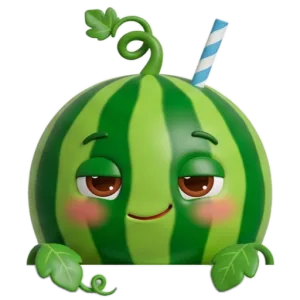
MeloMorning glass first, then everything else. That's the juicy order.
How many of those in-between refills you get depends on one setting. All of your crew's repeating reminders (water, eye breaks, posture checks and the rest) draw from a single daily allowance: 4 on Calm, 8 on Normal (the default) or 12 on Chatty. Chatty means more turns for everyone, water included. Press Done when you have had the glass, or Later if you are mid-sentence and it returns once, 20 minutes on. Notchpals doesn't add up liters or log what you drink. It takes your word for it and leaves the measuring to your thirst.
The short version
- There is no single right amount. Official figures put total water, from food and drink together, at roughly 2 to 2.7 liters a day for women and 2.5 to 3.7 liters for men.
- Tea, coffee, milk and watery food all count toward it.
- For healthy adults, thirst and pale yellow urine are good everyday guides.
- Heat, exercise, size, pregnancy and illness raise your needs. Some medical conditions lower them, and a doctor's advice comes first.
- At work, aim for a rhythm rather than a number: a glass to start, a refill mid-morning, one with lunch, one mid-afternoon and one before you finish.
More on water
 WaterSpilled water on a MacBook: what to do, and how to prevent itThe calm, exact steps to take if you spill a drink on a MacBook, what not to do (no rice, no hair dryer), and how to keep water on your desk safely.
 WaterHow to make drinking water a habit at your deskMake water a desk habit: tie sips to meetings and breaks, pick a glass you like, keep it in sight, flavor it without sugar and skip the counting.
- WaterHow to set a water reminder on your MacSet a water reminder on a Mac with Reminders, Calendar or Shortcuts, the honest pros and cons of each, and why a reminder that knows your context works better.